
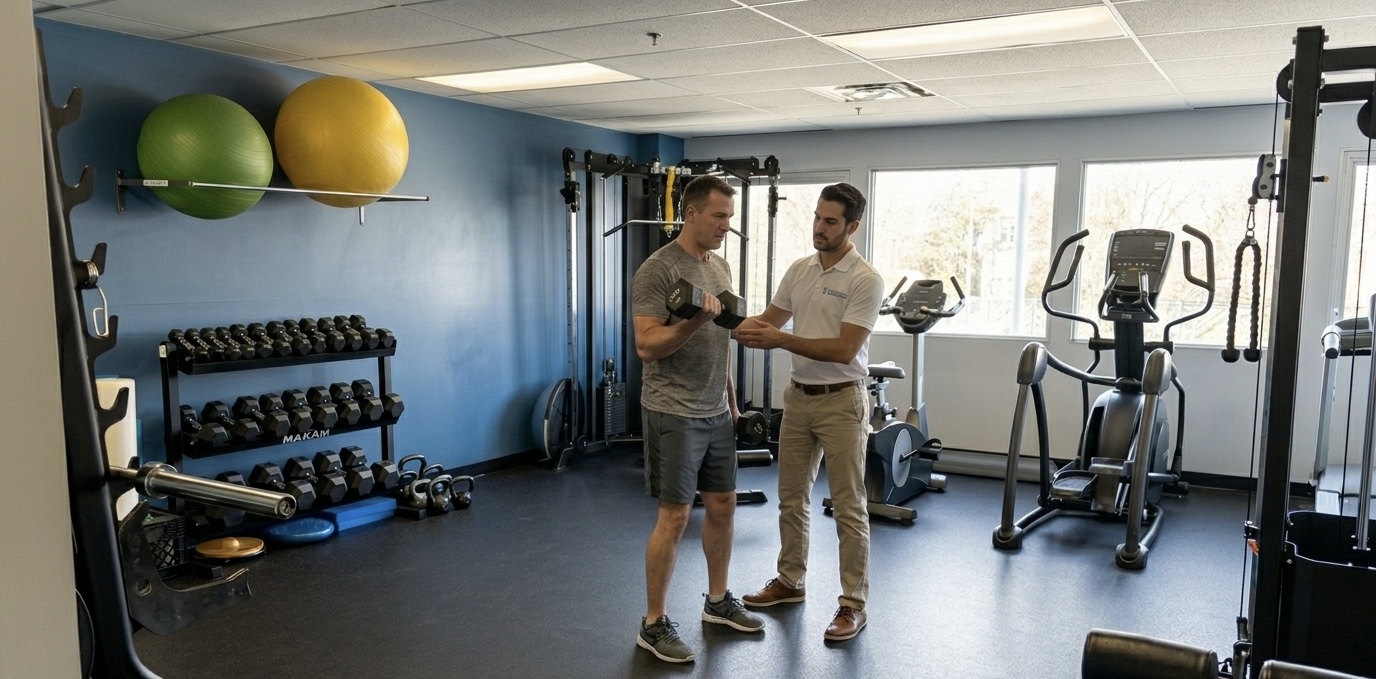
If you have pain on the outside of your elbow when gripping, lifting, typing, playing tennis or pickleball, working with tools, or even picking up a coffee mug, you may be dealing with tennis elbow.
Despite its name, tennis elbow isn’t just a tennis injury. It can affect anyone who repeatedly loads the muscles and tendons of the forearm—including people who work in construction or trades, office workers, weightlifters, golfers, racquet-sport players, and people who suddenly increase their activity.
The good news is that most cases can be managed without surgery. The key is identifying what is contributing to your symptoms and gradually rebuilding the elbow’s ability to tolerate the activities you need and want to do. Current physiotherapy guidelines support exercise-based rehabilitation, patient education and appropriate load management as important components of treatment. (APTA)
If you’re looking for tennis elbow treatment in Hamilton, this guide explains what tennis elbow is, what causes it, which exercises can help, how long recovery can take, and what you can expect from physiotherapy.
What Is Tennis Elbow?
Tennis elbow is commonly called lateral epicondylitis, although the term lateral elbow tendinopathy is often more accurate.
The condition involves the tendons that connect several of the forearm muscles to the outside of your elbow. These muscles help extend your wrist and fingers and are heavily involved in gripping and controlling your hand.
When the tendon is exposed to more load than it is currently prepared to handle—particularly repetitive gripping, lifting or wrist movements—it can become painful and less tolerant of activity.
Importantly, tennis elbow isn’t simply an inflammation problem. The tendon can undergo changes in its structure and capacity to tolerate load, particularly when symptoms have been present for a longer period. This is one reason why simply taking anti-inflammatory medication or completely resting the arm may not address the underlying problem. (PubMed)
Think of it less as an elbow that is “damaged and needs complete rest” and more as a tendon that needs the right amount of progressive loading.
Do You Have to Play Tennis to Get Tennis Elbow?
No.
In fact, most people with tennis elbow don’t develop it from playing tennis.
The name comes from the fact that the condition is common among racquet-sport athletes, but the same tissues can be overloaded by many other activities.
Common triggers include:
- Tennis and pickleball
- Weightlifting
- Pull-ups and rows
- Repetitive computer or mouse use
- Construction and skilled trades
- Plumbing and electrical work
- Gardening
- Painting
- Cooking
- Repetitive assembly-line work
- Carrying children
- Heavy lifting
- Repeated gripping or twisting
- A sudden increase in exercise or work demands
A common pattern is that someone changes their activity level and the elbow gradually becomes more painful.
For example, you might start playing pickleball three times a week after rarely playing before. Or you might spend a weekend doing renovations and notice elbow pain a few days later.
The activity itself isn’t necessarily “bad.” The problem may be that the amount of load increased faster than your tissues could adapt.
What Does Tennis Elbow Feel Like?
Tennis elbow usually causes pain around the outside of the elbow, near the bony prominence called the lateral epicondyle.
You may notice pain when:
- Gripping an object
- Shaking someone’s hand
- Opening a jar
- Turning a screwdriver
- Carrying groceries
- Picking up a coffee mug
- Lifting weights
- Using a computer mouse
- Extending your wrist
- Playing tennis or pickleball
- Lifting something with your palm facing down
Some people also experience aching or weakness extending down the outside of the forearm.
You may notice that your grip feels weaker—not necessarily because the muscles have suddenly lost all their strength, but because gripping can become painful.
A simple example
Imagine holding a heavy frying pan with your arm out in front of you.
Your forearm muscles have to work hard to stabilize your wrist while your hand grips the pan.
If the tissues around the outside of your elbow aren’t tolerating that load well, the activity can reproduce your symptoms.
Is My Elbow Pain Actually Tennis Elbow?
This is an important question because not every case of outer-elbow pain is tennis elbow.
A physiotherapist will consider several possibilities during an assessment, including:
- Lateral elbow tendinopathy
- Radial tunnel or nerve-related problems
- Elbow joint irritation
- Ligament injuries
- Referred pain from the neck
- Muscle strains
- Arthritis
- Acute traumatic injuries
The location and behaviour of your symptoms, your history and physical examination can help distinguish these conditions.
Imaging is not routinely necessary when the clinical presentation is straightforward. Current guidance suggests considering imaging when there is diagnostic uncertainty or concern about another condition. (PubMed Central (PMC))
This is one of the advantages of seeing a physiotherapist rather than simply assuming every painful elbow is “tennis elbow.”
What Causes Tennis Elbow?
There usually isn’t one single cause.
Instead, tennis elbow often develops when the demands placed on the elbow exceed the tissue’s current capacity.
Some common contributing factors include:
Sudden increases in activity
You dramatically increase your tennis, pickleball, gym, work or recreational activity.
Repetitive gripping
Repeatedly gripping tools, racquets, weights or equipment can increase the demand on the forearm muscles.
Repetitive wrist movements
Activities involving repeated wrist extension can place substantial demands on the extensor tendons.
Poor load management
You may be able to perform an activity occasionally without symptoms but develop pain when you suddenly increase the frequency, duration or intensity.
Reduced strength or conditioning
If the forearm and upper limb aren’t accustomed to the demands you’re placing on them, relatively normal activities can become excessive.
Work demands
Tennis elbow can be particularly frustrating when the activity causing the symptoms is also how you earn your living.
That is why treatment shouldn’t simply focus on avoiding the painful movement. Your rehabilitation plan should consider what you need to be able to do at work and how to gradually get you back there.
Should I Rest Tennis Elbow?
Usually, you don’t need to completely stop using your arm.
Instead, the goal is often relative rest and load modification.
That means temporarily reducing or changing activities that significantly aggravate your symptoms while continuing to move and use the arm within a tolerable range.
For example, you might temporarily:
- Reduce the weight you’re lifting.
- Decrease the number of pickleball or tennis sessions.
- Avoid repeated heavy gripping.
- Use two hands when carrying heavier objects.
- Take more frequent breaks during repetitive work.
- Modify exercises that heavily load the wrist.
- Reduce the intensity rather than stopping activity altogether.
Complete rest can reduce symptoms temporarily, but your tendon eventually needs to regain its capacity to tolerate normal activity.
That’s where progressive strengthening becomes important.
The Best Tennis Elbow Exercises
Exercise selection should be individualized, but strengthening the wrist and forearm is an important part of rehabilitation.
The exact exercises, resistance and dosage should depend on how irritable your symptoms are and what you can currently tolerate.
Here is an example of a progressive approach.
Exercise 1: Wrist Extensor Isometric
This can be useful when gripping and wrist movements are painful.
How to do it
- Sit with your forearm supported on a table.
- Position your wrist so your hand extends slightly beyond the edge.
- Place your opposite hand over the back of the affected hand.
- Gently try to lift the affected wrist upward while your other hand prevents the movement.
- Hold the contraction without actually moving the wrist.
- Relax.
Start with approximately 20–30 second holds for 3–5 repetitions, provided this is comfortable for you.
The goal is to introduce a controlled amount of load without significantly increasing your symptoms.
Exercise 2: Wrist Extension With a Dumbbell
Once your symptoms are more manageable, you can progress to dynamic strengthening.
How to do it
- Rest your forearm on a table with your palm facing downward.
- Allow your wrist to move beyond the edge of the table.
- Hold a light dumbbell.
- Slowly lower your hand toward the floor.
- Slowly raise your wrist back up.
- Keep the movement controlled rather than using momentum.
Start with a light weight.
You don’t need to lift a heavy dumbbell to make this exercise useful.
As your capacity improves, gradually increase the resistance.
Progressive wrist and forearm strengthening is a commonly recommended component of tennis elbow rehabilitation. (Choose PT)
Exercise 3: Eccentric Wrist Extension
Eccentric loading means the muscle is working while it lengthens.
How to do it
- Rest your forearm on a table with your palm facing downward.
- Hold a light dumbbell in the affected hand.
- Use your other hand to help lift the affected wrist upward.
- Slowly lower the affected wrist back down over approximately 3–5 seconds.
- Use your opposite hand to help bring it back to the starting position.
- Repeat.
As your symptoms and strength improve, you can eventually progress to performing both the lifting and lowering portions yourself.
Exercise 4: Grip Strengthening
Grip strength is important because many everyday activities require the hand and forearm to work together.
How to do it
- Hold a soft ball, therapy putty or grip device.
- Squeeze gently.
- Hold for several seconds.
- Slowly release.
- Repeat.
Don’t assume that squeezing as hard as possible is better.
The appropriate resistance should challenge the muscles without causing a significant flare-up afterward.
Exercise 5: Forearm Rotation
The muscles around your elbow also help rotate the forearm.
How to do it
- Hold a light hammer, dumbbell or similar object.
- Keep your elbow bent around 90 degrees.
- Slowly rotate your palm upward.
- Return to the starting position.
- Rotate your palm downward.
- Repeat in a controlled manner.
This can be particularly useful for people whose work or sport involves repeated twisting motions.
Exercise 6: Gradual Return to Your Sport or Work
This is the exercise that often gets forgotten.
Your final rehabilitation goal isn’t to be able to perform wrist curls in a clinic.
It’s to be able to:
- Play tennis.
- Play pickleball.
- Lift weights.
- Work a full shift.
- Use your tools.
- Carry groceries.
- Pick up your children.
- Garden.
- Do renovations.
Your physiotherapist can progressively expose the elbow to the movements and loads that matter to you.
For an athlete, that might mean progressing from controlled strengthening to hitting drills, then practice and eventually competition.
For a tradesperson, it might mean gradually increasing lifting, gripping and tool use.
How Much Pain Is Okay During Tennis Elbow Exercises?
This is one of the most common questions patients ask.
You don’t necessarily need to wait until your elbow is completely pain-free before exercising.
Some discomfort during rehabilitation can be acceptable, but your overall symptom response matters.
A useful principle is:
The exercise shouldn’t cause a substantial or prolonged worsening of your symptoms.
For example, mild discomfort during an exercise that settles afterward may be acceptable for some people.
On the other hand, if your elbow is significantly worse later that day or the following morning, the exercise may have been too intense.
That doesn’t necessarily mean the exercise is wrong.
It may simply mean you need to adjust:
- Weight
- Repetitions
- Sets
- Frequency
- Range of motion
- Exercise selection
A physiotherapist can help you determine the appropriate loading level.
How Long Does Tennis Elbow Take to Heal?
This is where tennis elbow can be frustrating.
There isn’t a single recovery timeline that applies to everyone.
Some people improve within several weeks, while others experience symptoms for several months.
Tennis elbow is often described as a condition that can resolve naturally over time, with some evidence suggesting many cases improve over approximately 6–12 months, although recovery varies considerably. (BMJ)
A longer recovery doesn’t necessarily mean something is seriously wrong.
Tendons adapt gradually to loading, and persistent symptoms can be influenced by:
- How long you’ve had the problem
- Your work demands
- Training volume
- Strength
- Sleep
- Stress
- Previous episodes
- How quickly you return to aggravating activities
- How consistently you complete your rehabilitation
A realistic rehabilitation timeline
Early stage:
The focus is on reducing unnecessary aggravation while maintaining appropriate movement and beginning tolerable loading.
Middle stage:
Strengthening becomes more progressive. The goal is to increase the elbow and forearm’s capacity.
Later stage:
Exercises become more demanding and increasingly resemble the activities you need to perform.
Return to activity:
You gradually return to your normal work, sport or exercise rather than going from “rest” straight back to full intensity.
Can I Keep Working Out With Tennis Elbow?
Often, yes.
You may not need to stop exercising altogether.
Instead, temporarily modify movements that significantly aggravate the elbow.
Depending on your symptoms, you may be able to continue:
- Lower-body training
- Cardio
- Core exercises
- Some pushing exercises
- Some pulling exercises
- Modified strength training
The specific modifications depend on what is causing your symptoms.
For example, someone with tennis elbow may tolerate a particular machine exercise but struggle with heavy dumbbell gripping.
The goal is to keep you active while managing the load on the irritated tissues.
Does a Tennis Elbow Brace Help?
A counterforce brace or wrist support may help some people manage symptoms during activities.
A brace can temporarily change how forces are distributed through the forearm and may make certain activities more comfortable.
However, a brace shouldn’t be viewed as a replacement for rehabilitation.
Think of it as a potential tool that can help you participate in activity while you’re rebuilding your capacity.
A physiotherapist can help determine whether a brace is appropriate and how it should be fitted and used. (Mayo Clinic Sports Medicine)
Does Massage Help Tennis Elbow?
Massage or manual therapy may provide short-term symptom relief and can sometimes make it easier to move or exercise.
However, passive treatment shouldn’t be the entire rehabilitation plan.
The longer-term goal is to improve the capacity of the muscles and tendons to tolerate the activities that caused the problem in the first place.
That generally means combining symptom-management strategies with progressive exercise and appropriate activity modification.
Does Shockwave Therapy Help Tennis Elbow?
Shockwave therapy is sometimes used for persistent tendon problems, including tennis elbow.
However, the evidence surrounding shockwave therapy for lateral elbow tendinopathy is mixed, and clinical guidelines do not all recommend it as a routine first-line treatment. One evidence-based pathway, for example, strongly recommends physiotherapy while recommending against routine shockwave treatment for lateral elbow tendinopathy. (PubMed Central (PMC))
That doesn’t mean every person will respond the same way.
It means shockwave therapy should be considered in the context of the individual’s diagnosis, symptoms, goals and overall rehabilitation plan rather than presented as a guaranteed solution.
For most people, the foundation should remain appropriate loading, strengthening, education and gradual return to activity.
What About Cortisone Injections?
Corticosteroid injections can sometimes provide short-term symptom relief, but they aren’t generally considered a preferred long-term solution for tennis elbow.
Research and clinical guidance have raised concerns about poorer longer-term outcomes compared with conservative rehabilitation in some patients. (Mayo Clinic Sports Medicine)
If you’re considering an injection, discuss the potential benefits and risks with the healthcare professional providing it.
Does Tennis Elbow Require Surgery?
Usually, no.
Most people with tennis elbow can be managed without surgery.
Surgery may occasionally be considered when symptoms remain persistent and significantly limiting despite an appropriate period of non-surgical treatment.
Mayo Clinic notes that surgery is generally considered only after approximately 6–12 months of unsuccessful conservative treatment. (Mayo Clinic)
The exact decision depends on the diagnosis, severity, duration of symptoms, functional limitations and response to treatment.
When Should You See a Physiotherapist for Tennis Elbow?
You don’t necessarily need to wait until your elbow becomes severe.
Consider booking an assessment if:
- Your elbow pain has persisted for several weeks.
- Pain is interfering with work.
- You can’t exercise normally.
- Grip strength feels reduced.
- You have stopped playing your sport because of pain.
- Everyday activities such as opening jars or carrying objects hurt.
- You have tried resting but symptoms keep returning.
- You aren’t sure whether your pain is actually tennis elbow.
- You want a structured plan for returning to work or sport.
In Ontario, you can generally access private physiotherapy directly without a physician referral. However, some extended health insurance plans may require a referral before they reimburse physiotherapy, so it’s worth checking your specific plan. (Ontario Physiotherapy Association)
What Happens During a Tennis Elbow Physiotherapy Assessment?
Your first appointment should be about more than simply finding the sore spot.
Your physiotherapist will typically ask about:
- When your symptoms started
- What caused or aggravated them
- Your work
- Your sport and exercise
- Previous injuries
- Your current limitations
- What movements make symptoms better or worse
- Your goals
They may assess:
- Elbow range of motion
- Wrist movement
- Grip strength
- Forearm strength
- Shoulder function
- Neck movement when appropriate
- Pain with resisted movements
- Functional movements
- Relevant neurological signs
The purpose is to determine whether your symptoms are consistent with lateral elbow tendinopathy and identify factors that may be contributing to the problem.
From there, your physiotherapist can develop a progressive rehabilitation plan.
How We Treat Tennis Elbow at Restorative Touch Physiotherapy
At Restorative Touch Physiotherapy, the goal isn’t simply to make your elbow feel better for an hour.
We want to understand why the elbow is struggling with its current workload and what it needs to return to normal activity.
Your treatment may include:
Education
Understanding what’s causing your symptoms can make it much easier to manage your activity and recovery.
Activity modification
We’ll help you determine which activities need to be temporarily reduced or modified—and which ones you can safely continue.
Progressive strengthening
We’ll build the capacity of your wrist, forearm and upper limb progressively rather than relying exclusively on passive treatments.
Manual therapy
Hands-on treatment may be used when appropriate to help manage symptoms and improve movement.
Home exercises
You’ll receive exercises that fit into your actual routine rather than a generic list that sits untouched on the fridge.
Return-to-sport or work rehabilitation
If you play tennis, pickleball, golf or another sport—or your job involves repetitive gripping and lifting—we can progressively prepare your elbow for those demands.
How Can I Prevent Tennis Elbow From Coming Back?
There isn’t a guaranteed way to prevent tennis elbow, but you can reduce the likelihood of recurrence by gradually building your capacity for the activities you perform.
Increase activity gradually
Avoid going from very little activity to several hours of repetitive gripping or sport in a short period.
Strengthen regularly
Maintaining forearm and upper-limb strength can help you tolerate the demands of work and sport.
Pay attention to workload
It’s not necessarily one activity that causes the problem. A sudden increase in the total amount of activity can matter.
Don’t ignore recurring symptoms
If the elbow repeatedly becomes painful every time you return to an activity, that’s useful information.
Instead of repeatedly resting until the pain disappears and then returning to the same workload, consider addressing the underlying capacity and load-management issue.
Prepare for your sport
If you’re returning to tennis or pickleball after a long break, gradually increase playing time rather than immediately returning to your previous schedule.
Frequently Asked Questions About Tennis Elbow
How do I know if I have tennis elbow?
Pain on the outside of the elbow that is aggravated by gripping, lifting or resisted wrist movements is commonly associated with tennis elbow. However, other conditions can cause similar symptoms, so an assessment is recommended if you’re uncertain.
Can tennis elbow go away on its own?
Yes. Many cases improve over time, particularly when aggravating activities are appropriately modified. However, persistent or recurrent symptoms may benefit from a structured rehabilitation program. (PubMed)
How long does tennis elbow last?
Recovery varies. Some people improve within weeks, while others experience symptoms for several months. Persistent cases can take 6–12 months or longer to fully settle.
Should I ice tennis elbow?
Ice may temporarily reduce pain for some people, but it isn’t considered the main treatment for chronic tennis elbow. Progressive rehabilitation and appropriate load management are more important for restoring function.
Should I use heat?
Heat may feel good and can temporarily reduce stiffness, but like ice, it doesn’t replace rehabilitation.
Should I stretch tennis elbow?
Gentle stretching can sometimes help with mobility and comfort, but strengthening and progressive loading are particularly important for rebuilding tendon capacity.
Can I play tennis with tennis elbow?
Possibly, depending on your symptoms.
You may need to temporarily modify playing frequency, duration, intensity or technique before gradually returning to your normal level.
Can I play pickleball with tennis elbow?
Yes, in some cases, but you may need to modify your playing schedule and workload. Pickleball involves repetitive gripping and wrist activity, so returning too quickly can continue to overload the tendon.
Is tennis elbow the same as golfer’s elbow?
No.
Tennis elbow usually causes pain on the outside of the elbow, while golfer’s elbow generally involves pain on the inside of the elbow.
Do I need an MRI for tennis elbow?
Usually not when the clinical presentation is straightforward. Imaging may be considered when the diagnosis is uncertain or another condition is suspected. (PubMed Central (PMC))
Can massage fix tennis elbow?
Massage may help manage symptoms, but it shouldn’t be considered a standalone cure. A comprehensive rehabilitation plan should address strength, loading and the activities contributing to the problem.
Does physiotherapy actually work for tennis elbow?
Physiotherapy is an evidence-supported treatment option for lateral elbow tendinopathy. Current clinical guidance supports rehabilitation that includes appropriate exercise, education and management of contributing factors. (APTA)
Do I need a doctor’s referral for physiotherapy in Hamilton?
For private physiotherapy in Ontario, you generally do not need a physician referral. Some insurance plans may still require one for reimbursement, so check your benefits before your appointment. (Ontario Physiotherapy Association)
When Should Elbow Pain Be Assessed Urgently?
Most tennis elbow cases are not emergencies.
However, you should seek appropriate medical assessment if your elbow pain follows significant trauma, you have a visible deformity, severe swelling, significant loss of movement, progressive weakness or numbness, or other symptoms that don’t fit the typical pattern of tennis elbow.
A physiotherapist can also help determine whether your symptoms appear consistent with a musculoskeletal problem or whether you should be referred for further medical investigation.
Tennis Elbow Treatment in Hamilton
If elbow pain is preventing you from working, exercising, playing tennis or pickleball, or enjoying everyday activities, you don’t necessarily have to simply wait for it to disappear.
The most effective rehabilitation approach is usually not about finding one magic treatment.
It’s about understanding the problem, modifying the right activities, progressively strengthening the affected tissues and gradually returning to the activities that matter to you.
At Restorative Touch Physiotherapy in Hamilton, our physiotherapists can assess your elbow, determine what may be contributing to your symptoms and develop an individualized plan to help you return to work, sport and everyday activities.
Located on Hamilton Mountain, Restorative Touch Physiotherapy provides individualized physiotherapy and rehabilitation for elbow, shoulder, sports and workplace injuries.
If you’re dealing with persistent elbow pain or you’re unsure whether you have tennis elbow, an assessment can help you understand what’s going on and what your next steps should be.
Book a physiotherapy assessment at Restorative Touch Physiotherapy.