
If you’ve been dealing with stubborn tendon, muscle or joint pain that doesn’t seem to be improving, you may have come across shockwave therapy.
But what exactly is shockwave therapy?
Does shockwave physiotherapy actually work?
Is it painful?
How many treatments do you need?
And most importantly—is shockwave therapy right for your injury?
At Restorative Touch Physiotherapy on Hamilton Mountain, we use shockwave therapy as part of a comprehensive rehabilitation plan for appropriate patients.
Shockwave therapy isn’t a magic fix, and it isn’t appropriate for every injury. However, for certain persistent musculoskeletal conditions—particularly some tendon and soft-tissue problems—it can be a useful tool alongside progressive exercise and physiotherapy.
This guide explains everything you should know before booking shockwave physiotherapy in Hamilton, including how it works, what conditions it may help, what treatment feels like, how long recovery takes and what you should expect from your physiotherapist.
What Is Shockwave Therapy?
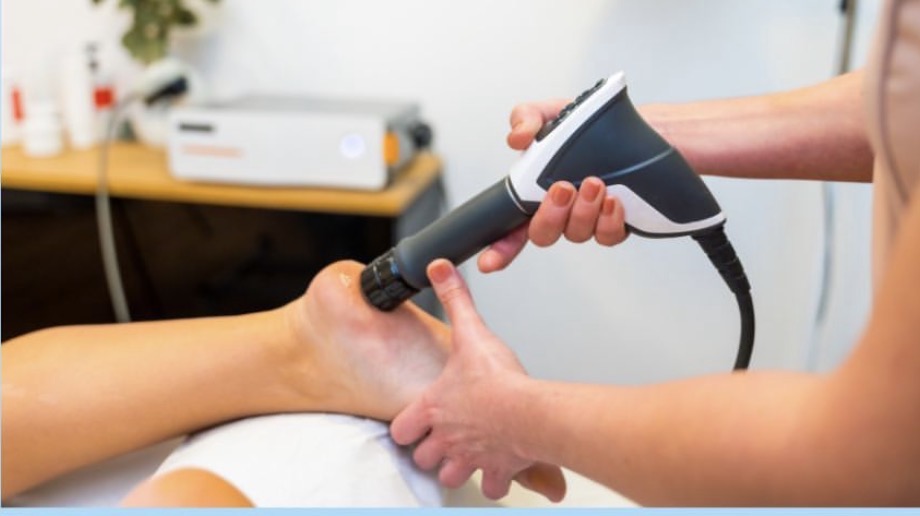
Shockwave therapy is a non-invasive treatment that uses acoustic pressure waves to deliver mechanical energy to a targeted area of the body.
Unlike electrical stimulation or ultrasound, shockwave therapy uses mechanical pressure waves.
The treatment is delivered through a handheld applicator placed against the skin.
The physiotherapist applies the treatment to the affected area while adjusting the intensity and location based on your symptoms and clinical assessment.
Shockwave therapy is sometimes referred to as:
- Extracorporeal shockwave therapy (ESWT)
- Radial shockwave therapy
- Radial pressure wave therapy
- Shockwave treatment
The exact technology and terminology can vary between devices and clinics.
How Does Shockwave Therapy Work?
Shockwave therapy creates mechanical stimulation in the tissues being treated.
This stimulation may influence several biological and neurological processes, including:
- Pain modulation
- Local tissue responses
- Blood flow
- Cellular activity
- Tendon remodeling
- The body’s response to persistent tissue problems
The exact biological mechanisms are complex and continue to be studied.
One important point is that shockwave therapy isn’t simply “breaking up scar tissue.”
You may see that explanation online, but it oversimplifies what the treatment is actually doing.
What Does Shockwave Therapy Treat?
Shockwave therapy is most commonly considered for persistent musculoskeletal conditions, particularly certain tendon-related problems.
Depending on the clinical presentation, it may be used for conditions such as:
- Plantar fasciitis / plantar heel pain
- Achilles tendinopathy
- Patellar tendinopathy
- Tennis elbow
- Certain rotator cuff-related shoulder conditions
- Chronic tendon pain
- Some persistent muscle or soft-tissue conditions
Not every person with one of these diagnoses is automatically a good candidate.
The diagnosis, duration of symptoms, irritability and previous treatment all matter.
Shockwave Therapy for Plantar Fasciitis
Plantar heel pain is one of the conditions commonly associated with shockwave therapy.
People often describe:
- Pain under the heel
- Pain with their first steps in the morning
- Pain after sitting
- Pain after prolonged standing
- Pain while walking or running
Shockwave may be considered when symptoms have persisted despite an appropriate rehabilitation program.
Treatment is often combined with:
- Calf strengthening
- Foot strengthening
- Load management
- Mobility exercises
- Footwear modifications
Shockwave shouldn’t replace the rehabilitation component.
Shockwave Therapy for Achilles Tendon Pain
Achilles tendinopathy can cause pain around the Achilles tendon, particularly during:
- Running
- Jumping
- Walking uphill
- Calf raises
- Sports
Progressive calf strengthening is a cornerstone of rehabilitation.
Shockwave may be considered as an adjunct in persistent cases.
The goal isn’t simply to reduce pain.
It’s to progressively restore the tendon’s ability to tolerate load.
Shockwave Therapy for Tennis Elbow
Tennis elbow can occur in anyone—not just tennis players.
It may develop with repetitive:
- Gripping
- Lifting
- Wrist movements
- Tool use
- Manual work
- Racquet sports
Shockwave therapy may be considered for persistent cases.
It can be combined with:
- Forearm strengthening
- Grip strengthening
- Load modification
- Work modifications
- Gradual return to sport
Shockwave Therapy for Shoulder Pain
Shockwave therapy can sometimes be used for specific shoulder conditions, particularly some persistent tendon-related problems.
However, shoulder pain has many possible causes.
A shoulder assessment is important before deciding whether shockwave is appropriate.
For example, treatment for a rotator cuff-related problem may include:
- Rotator cuff strengthening
- Scapular strengthening
- Mobility work
- Activity modification
- Progressive overhead loading
Shockwave may be one component rather than the entire treatment.
Is Shockwave Therapy Good for Chronic Pain?
Shockwave therapy is generally most relevant when there is a specific musculoskeletal condition that may respond to the treatment.
“Chronic pain” is a broad category.
Not all chronic pain responds to shockwave therapy.
Persistent pain can involve changes in:
- Tissue sensitivity
- Nervous-system processing
- Movement
- Strength
- Sleep
- Stress
- Physical activity
That’s why a proper assessment is important.
Is Shockwave Therapy the Same as Ultrasound?
No.
Both use sound-based energy, but they are different technologies.
Shockwave therapy uses high-energy acoustic pressure waves designed to produce a mechanical stimulus.
Therapeutic ultrasound uses high-frequency sound waves delivered continuously or in pulses.
They aren’t interchangeable treatments.
Is Shockwave Therapy the Same as Massage?
No.
Massage primarily involves manual pressure and movement of soft tissues.
Shockwave therapy uses acoustic pressure waves delivered through a treatment applicator.
Both may be used in physiotherapy, but they work differently and have different purposes.
Is Shockwave Therapy the Same as Acupuncture?
No.
Acupuncture uses very thin needles inserted into specific areas of the body.
Shockwave therapy uses a handheld applicator that delivers acoustic pressure waves through the skin.
Some physiotherapy clinics offer both treatments, but they are distinct therapies.
Does Shockwave Therapy Hurt?
This is probably the most common question.
It can be uncomfortable.
The sensation depends on:
- The condition being treated
- The location
- The sensitivity of the tissue
- The intensity of treatment
- Your individual tolerance
Patients often describe the sensation as:
- Tapping
- Pulsing
- Pressure
- A sharp or uncomfortable sensation
The intensity can be adjusted.
The goal isn’t to make treatment unnecessarily painful.
Your physiotherapist should communicate with you throughout the session and adjust the treatment based on your response.
How Long Does a Shockwave Treatment Take?
A typical shockwave treatment is relatively short.
The treatment itself may take approximately 5–15 minutes, depending on the area being treated and the treatment plan.
Your overall appointment may be longer because your physiotherapist may also perform:
- Assessment
- Exercise instruction
- Manual therapy
- Education
- Rehabilitation planning
The goal is to treat the underlying problem—not simply administer shockwave and send you home.
How Many Shockwave Treatments Do I Need?
There isn’t one universal number.
A common treatment course may involve approximately 3–6 sessions, often spaced about a week apart.
However, the appropriate number depends on:
- Your diagnosis
- How long you’ve had symptoms
- Your response to treatment
- The treatment area
- Your rehabilitation program
More treatment isn’t automatically better.
Your physiotherapist should reassess your progress rather than simply scheduling an arbitrary number of sessions.
How Quickly Does Shockwave Therapy Work?
Some people notice changes relatively early in their treatment.
Others don’t notice significant improvement until several weeks after treatment begins.
Shockwave isn’t necessarily designed to provide immediate pain relief.
Some of its proposed effects involve longer-term tissue and pain-modulation processes.
Your response will depend on the condition being treated and the rehabilitation program surrounding it.
Can Shockwave Therapy Make You Sore?
Yes.
Temporary soreness or tenderness after treatment can occur.
Some people describe the treated area as feeling similar to a workout or deep tissue treatment.
This generally settles relatively quickly.
Your physiotherapist will provide guidance about activity following treatment.
What Should I Do After Shockwave Therapy?
In many cases, you can continue normal daily activities.
However, depending on the condition being treated, you may be advised to temporarily modify higher-load activities.
For example, if you’re receiving shockwave for Achilles tendinopathy, you may need to adjust:
- Running
- Jumping
- Sprinting
- High-volume calf loading
You shouldn’t assume that more activity is always better simply because you received treatment.
Your rehabilitation plan should determine how much load is appropriate.
Can I Exercise After Shockwave Therapy?
Often, yes—but the answer depends on what you’re treating.
For many tendon conditions, exercise is actually an important part of the treatment plan.
The question isn’t whether you should exercise.
It’s:
How much exercise can your tissue currently tolerate?
Your physiotherapist can help determine appropriate loading before and after treatment.
Is Shockwave Therapy a Standalone Treatment?
It can be used on its own in some situations, but it is generally more useful when incorporated into a broader rehabilitation plan.
For tendon problems, for example, progressive strengthening is extremely important.
Shockwave may help address pain or stimulate a response, while exercise helps rebuild the physical capacity of the tissue.
Think of it as:
Shockwave + rehabilitation
rather than:
Shockwave instead of rehabilitation.
Why Combine Shockwave Therapy With Physiotherapy?
This is one of the biggest advantages of receiving shockwave from a physiotherapist.
Your physiotherapist can determine:
- What is actually causing your symptoms.
- Whether shockwave is appropriate.
- Where it should be applied.
- What exercises you need.
- How much activity you should do.
- How to progress your rehabilitation.
Without addressing these factors, simply treating the painful area may not solve the underlying problem.
Is Shockwave Therapy Evidence-Based?
Shockwave therapy has been studied extensively for several musculoskeletal conditions.
Evidence is particularly relevant for certain persistent tendon problems and plantar heel pain.
However, results vary depending on:
- The diagnosis
- Treatment protocol
- Type of shockwave device
- Patient characteristics
- Duration of symptoms
- Whether rehabilitation is also provided
This is why responsible physiotherapy clinics shouldn’t claim that shockwave “cures everything.”
The treatment needs to match the condition.
Who Is a Good Candidate for Shockwave Therapy?
You may be a candidate if you have:
- Persistent tendon pain
- Plantar heel pain
- Achilles tendon pain
- Tennis elbow
- Certain rotator cuff-related conditions
- Symptoms that haven’t improved as expected
- A condition for which shockwave has reasonable clinical evidence
A physiotherapy assessment is the best way to determine whether you’re a suitable candidate.
Who May Not Be a Good Candidate?
Shockwave therapy isn’t appropriate for everyone.
Your physiotherapist will consider your medical history and the specific area being treated.
Certain medical circumstances may make shockwave inappropriate or require medical clearance.
Examples can include some:
- Bleeding disorders
- Blood-thinning medication situations
- Pregnancy-related considerations depending on treatment area
- Active infection
- Certain neurological conditions
- Certain implanted devices or medical conditions
Shockwave should not be applied indiscriminately.
If you’re unsure whether it’s appropriate for you, speak with your physiotherapist before treatment.
Are There Side Effects?
Most side effects are temporary.
Possible effects include:
- Temporary soreness
- Tenderness
- Redness
- Mild swelling
- Bruising
- Temporary increase in pain
Your physiotherapist should explain the expected response before treatment.
If you experience unusual or severe symptoms, contact an appropriate healthcare professional.
Is Shockwave Therapy Safe?
Shockwave therapy is generally considered a non-invasive treatment when appropriately administered.
However, “non-invasive” doesn’t mean risk-free.
That’s why treatment should be provided following an appropriate clinical assessment.
The treatment intensity and location should be selected based on your condition and individual circumstances.
Can Shockwave Therapy Break Up Scar Tissue?
You may hear that shockwave therapy “breaks up scar tissue.”
That’s an oversimplification.
The treatment creates mechanical stimulation that can influence tissues and pain responses.
The biological effects are more complex than physically smashing scar tissue apart.
Does Shockwave Therapy Increase Blood Flow?
Shockwave therapy can influence local physiological responses, including blood-flow-related effects.
However, increased blood flow alone doesn’t explain all of its potential effects.
Its proposed mechanisms include several biological and neurological processes.
Does Shockwave Therapy Heal Tendons?
Shockwave therapy may help support recovery in some persistent tendon conditions.
But tendons also need progressive loading.
A tendon becomes more capable when it is appropriately exposed to increasing physical demands.
That’s why a successful treatment plan usually involves more than shockwave sessions.
Shockwave Therapy vs Physiotherapy
This isn’t really an either/or decision.
Shockwave therapy is a treatment modality.
Physiotherapy is a broader rehabilitation profession that can include:
- Assessment
- Exercise prescription
- Manual therapy
- Education
- Load management
- Movement rehabilitation
- Return-to-sport planning
Shockwave can be incorporated into physiotherapy when appropriate.
Shockwave Therapy vs Cortisone Injection
These are very different treatments.
Cortisone injections involve medication delivered into a specific area.
Shockwave therapy uses mechanical acoustic energy without injecting medication.
Which treatment is appropriate depends on the diagnosis and individual circumstances.
A healthcare professional can help you determine the best option.
How Much Does Shockwave Therapy Cost in Hamilton?
Shockwave treatment pricing varies between clinics and may depend on:
- Number of areas treated
- Whether it is included within a physiotherapy appointment
- Length of appointment
- Treatment plan
- Clinic
Rather than choosing a clinic solely based on the lowest price, consider whether the treatment includes an assessment and rehabilitation plan.
A cheap shockwave session isn’t particularly valuable if nobody has determined why you’re in pain.
Why You Shouldn’t Just Book Shockwave Without an Assessment
This is important.
Not every painful tendon needs shockwave.
Not every heel pain problem is plantar fasciitis.
Not every shoulder problem is a rotator cuff issue.
And not every chronic pain problem will respond to shockwave.
An assessment helps determine:
What is causing your symptoms?
Is shockwave appropriate?
What else needs to be addressed?
What should your rehabilitation look like?
That’s what turns a treatment modality into a treatment plan.
What Happens at Your First Shockwave Physiotherapy Appointment?
At Restorative Touch Physiotherapy, your appointment begins with an assessment.
We’ll discuss:
- Your symptoms
- When they started
- How the problem developed
- What makes it better or worse
- Your activity level
- Your work and sport
- Previous treatment
- Your goals
We’ll then assess the relevant area and determine whether shockwave is appropriate.
If it is, we’ll explain:
- What we’re treating
- Why we’re using shockwave
- What you should expect
- How frequently treatment should occur
- What exercises you should perform
- How to modify your activities
The treatment is then integrated into your broader rehabilitation plan.
What Makes Shockwave Physiotherapy Different?
The biggest difference is that shockwave shouldn’t be treated as a standalone gadget.
Your physiotherapist should understand the condition being treated and how it responds to load.
For example, if you have Achilles tendinopathy, we don’t simply treat the Achilles tendon.
We also need to consider:
- Calf strength
- Running volume
- Training frequency
- Foot and ankle function
- Recovery
- Sport demands
If you have tennis elbow, we may also consider:
- Grip strength
- Forearm strength
- Work demands
- Racquet or equipment use
- Repetitive loading
The treatment needs to make sense for you.
How to Get the Most From Shockwave Therapy
If you’re undergoing shockwave treatment, don’t think of each appointment as the entire solution.
Your results may depend on what you do between appointments.
Follow your exercise program
The exercises are often a key part of rebuilding tissue capacity.
Manage your activity
Don’t repeatedly overload the area while expecting treatment to compensate.
Be patient
Persistent conditions often take time to improve.
Communicate
Tell your physiotherapist how you’re responding.
Progress gradually
The goal is to return to normal activity—not remain dependent on treatment.
Shockwave Physiotherapy in Hamilton Mountain
If you’ve been searching for shockwave Hamilton, shockwave Hamilton Mountain, or a shockwave physiotherapist, the most important thing isn’t simply finding a clinic with a shockwave machine.
You want someone who can determine:
Why you’re hurting.
Whether shockwave is appropriate.
What else needs to be treated.
How to rebuild your physical capacity.
At Restorative Touch Physiotherapy on Hamilton Mountain, shockwave therapy can be incorporated into a comprehensive physiotherapy program for appropriate conditions.
Depending on your assessment, your treatment may include:
- Shockwave therapy
- Exercise therapy
- Progressive strengthening
- Manual therapy
- Mobility exercises
- Load management
- Activity modification
- Running or sport-specific rehabilitation
- Return-to-work rehabilitation
- Education
Our goal isn’t to keep you coming back for shockwave treatments forever.
The goal is to help you become strong enough that you don’t need treatment.
Frequently Asked Questions About Shockwave Therapy
What is shockwave therapy?
Shockwave therapy uses acoustic pressure waves to deliver mechanical energy to targeted tissues. It is commonly used as part of treatment for certain persistent musculoskeletal conditions.
Does shockwave therapy work?
Evidence supports its use for several musculoskeletal conditions, particularly certain persistent tendon problems and plantar heel pain. Its effectiveness depends on the condition and treatment approach.
Is shockwave therapy painful?
It can be uncomfortable, but treatment intensity can generally be adjusted to your tolerance.
How many shockwave treatments do I need?
Many treatment plans involve approximately 3–6 sessions, often spaced about a week apart, but the appropriate number varies by condition and individual response.
How long does shockwave therapy take?
The shockwave portion of treatment often takes approximately 5–15 minutes, although your overall physiotherapy appointment may be longer.
What does shockwave therapy feel like?
Patients commonly describe tapping, pulsing, pressure or discomfort at the treatment site.
Can I exercise after shockwave therapy?
Often yes, although the appropriate amount of exercise depends on your condition and treatment plan.
Can shockwave therapy cure plantar fasciitis?
Shockwave may help some people with persistent plantar heel pain, particularly when combined with appropriate rehabilitation.
Can shockwave therapy help tennis elbow?
It may be considered for persistent tennis elbow, particularly when symptoms haven’t improved with appropriate conservative management.
Can shockwave therapy help Achilles tendinopathy?
It may be useful for some persistent Achilles tendon problems, particularly as an adjunct to progressive loading.
Can shockwave therapy help shoulder pain?
It may be appropriate for certain shoulder conditions, particularly some persistent tendon-related problems. A proper assessment is important first.
Is shockwave therapy the same as acupuncture?
No. Shockwave uses acoustic pressure waves, while acupuncture uses needles.
Is shockwave therapy the same as ultrasound?
No. They use different technologies and have different treatment mechanisms.
Are there side effects?
Temporary soreness, tenderness, redness, swelling or bruising can occur.
Is shockwave therapy safe?
It is generally considered a safe non-invasive treatment when appropriately administered, but it isn’t suitable for every person or every condition.
Can shockwave therapy replace physiotherapy?
Not necessarily. Shockwave is a treatment modality, while physiotherapy includes assessment, exercise, education, load management and rehabilitation. Combining them can be more useful than relying on shockwave alone.
Book Shockwave Physiotherapy in Hamilton
If you’re dealing with persistent tendon, heel, elbow, shoulder or other musculoskeletal pain, shockwave therapy may be worth considering—but the first step is determining whether it’s actually appropriate for you.
At Restorative Touch Physiotherapy on Hamilton Mountain, we don’t use shockwave simply because we have the equipment.
We use it when it makes clinical sense.
Your physiotherapist will assess your condition, explain your treatment options and build a rehabilitation plan around your goals.
If shockwave is appropriate, it can be combined with progressive exercise and other physiotherapy treatments to help you move from:
Pain → improved function → increased strength → return to normal activity.
If you’ve been searching for shockwave physiotherapy in Hamilton, shockwave Hamilton, shockwave Hamilton Mountain, or a shockwave physiotherapist, we’d be happy to assess whether this treatment is right for you.
Book an assessment at Restorative Touch Physiotherapy on Hamilton Mountain and find out whether shockwave therapy belongs in your recovery plan.