
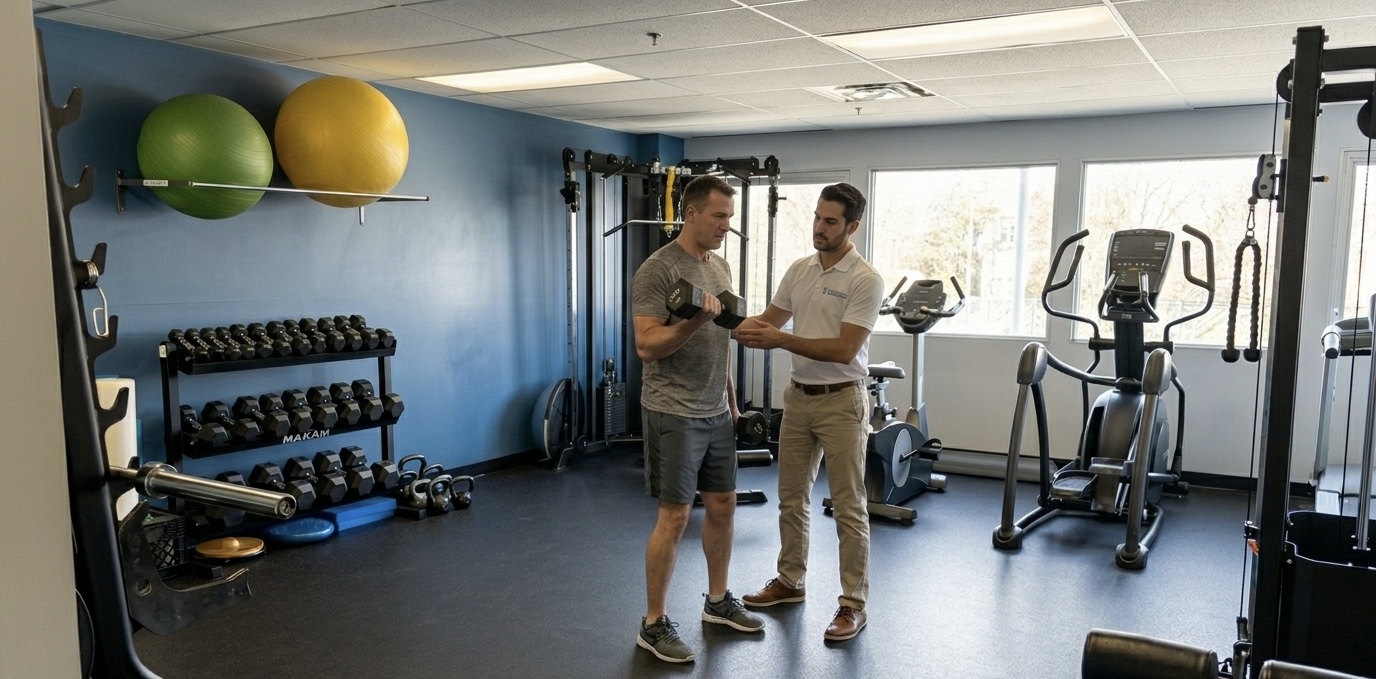
When most people think about physiotherapy, they might picture massage, stretching, joint mobilizations, or a therapist working on an injured area.
Those treatments can absolutely have a place in rehabilitation.
But at Restorative Touch Physiotherapy, we believe something else sits at the centre of recovery:
Movement.
More specifically, therapeutic exercise.
Therapeutic exercise is the purposeful use of movement and exercise to improve strength, mobility, balance, endurance, coordination, physical capacity, and confidence.
It’s different from simply “working out.”
A therapeutic exercise program is designed around you — your injury, your current abilities, your goals, your lifestyle, and the demands you eventually need your body to handle.
Whether you’re recovering from an injury, dealing with persistent pain, returning to sport, preparing for surgery, rebuilding strength, or simply trying to move better, therapeutic exercise can be one of the most important parts of the process.
At Restorative Touch, it isn’t an afterthought.
It’s at the foundation of what we do.
What Is Therapeutic Exercise?
Therapeutic exercise is structured physical activity prescribed and progressed to address a specific physical limitation or rehabilitation goal.
Depending on the person, that might mean improving:
- Strength
- Mobility
- Balance
- Coordination
- Endurance
- Stability
- Flexibility
- Power
- Movement control
- Physical confidence
- Tolerance to activity
The exercise itself could be very simple.
For one person, therapeutic exercise might mean learning how to perform a squat without pain.
For another, it might mean rebuilding a rotator cuff after surgery.
For an athlete, it could mean progressing from basic strengthening to sprinting and sport-specific drills.
For someone with persistent pain, it might begin with a few simple movements and gradually build toward normal daily activities.
The exercise isn’t necessarily special because it’s complicated.
It’s special because it’s purposeful, appropriately dosed, and progressively adapted to the person performing it.
Why Is Exercise So Important in Physiotherapy?
Your body adapts to the demands you place on it.
If you progressively challenge a muscle, it can become stronger.
If you gradually increase cardiovascular activity, your endurance can improve.
If you repeatedly practice a movement, your coordination can improve.
If you progressively expose a previously injured body part to load, your tolerance can increase.
This is one of the fundamental principles behind rehabilitation.
Rather than simply asking:
“How can we make this hurt less today?”
we also ask:
“How can we make your body better able to handle this tomorrow?”
That’s where therapeutic exercise becomes so important.
Therapeutic Exercise vs. Regular Exercise
Therapeutic exercise and regular exercise can look remarkably similar.
A squat is still a squat.
A calf raise is still a calf raise.
A row is still a row.
The difference is why you’re doing it, how it’s prescribed, and how it’s progressed.
A regular workout might be designed to improve general fitness.
A therapeutic exercise program might use a squat to:
- Rebuild leg strength after an injury
- Improve tolerance to stairs
- Prepare someone to return to running
- Restore strength after surgery
- Improve confidence with movement
The exercise is the tool.
The goal determines how we use it.
Why Does Therapeutic Exercise Work?
Exercise creates a stimulus.
Your body responds by adapting to that stimulus.
When appropriately programmed, exercise can help improve:
Strength
Muscles become better able to produce force.
Mobility
Regular movement and loading can help improve functional range of motion.
Capacity
Your body becomes better able to tolerate physical demands.
Coordination
Your nervous system becomes more efficient at controlling movement.
Balance
Your body learns to respond to changes in position and external forces.
Endurance
Your cardiovascular and muscular systems become better able to sustain activity.
Confidence
Perhaps one of the most overlooked benefits is psychological.
When you successfully perform something you previously couldn’t do, you begin to trust your body again.
Exercise Is More Than a List of Exercises
One of the biggest misconceptions about physiotherapy is that treatment means receiving a sheet of exercises.
But good rehabilitation isn’t about collecting exercises.
It’s about determining:
What does your body need right now?
Then:
What should it be able to do next?
And eventually:
What does it need to handle in your real life?
For example, someone recovering from knee surgery doesn’t simply need stronger quadriceps.
They may need to eventually:
- Walk normally
- Climb stairs
- Squat
- Run
- Jump
- Change direction
- Return to work
- Return to sport
The exercises should progressively prepare them for those demands.
The Importance of Progressive Overload
Your body adapts when it is appropriately challenged.
That’s why rehabilitation can’t remain at the same level forever.
Imagine you’ve been doing:
10 bodyweight squats
for six months.
At some point, your body has adapted.
If your goal is to become stronger, the exercise needs to become more challenging.
That might mean:
- More repetitions
- More resistance
- Greater range of motion
- More difficult variations
- Greater speed
- More complexity
- Less rest
This is called progressive overload.
It’s one of the fundamental principles of strength and rehabilitation.
But progression doesn’t mean simply making everything harder as quickly as possible.
The right amount of challenge matters.
Too little stimulus may not create enough adaptation.
Too much may exceed your current capacity and aggravate symptoms.
A good rehabilitation program finds the sweet spot.
How Do Physiotherapists Decide Which Exercises You Need?
Therapeutic exercise should begin with an assessment.
Your physiotherapist may look at:
- Strength
- Mobility
- Balance
- Coordination
- Movement patterns
- Pain
- Joint function
- Physical capacity
- Work demands
- Sport demands
- Previous injuries
- Your goals
But there’s another important factor:
What do you actually want to get back to?
A recreational runner and a professional hockey player may both have knee pain.
Their rehabilitation shouldn’t necessarily look the same.
The same applies to a construction worker and someone who works at a desk.
Your rehabilitation should eventually reflect the demands of your life.
Therapeutic Exercise for Pain
One of the most common reasons people seek physiotherapy is pain.
And when you’re hurting, exercise can feel like the last thing you want to do.
That’s understandable.
But appropriate movement can often be an important part of recovery.
The key word is appropriate.
Therapeutic exercise isn’t about forcing painful movements.
It’s about finding a level of movement and loading that your body can tolerate and gradually progressing from there.
For someone with persistent pain, that might mean starting with relatively simple exercises.
As confidence and capacity improve, the program can become progressively more demanding.
Does Exercise Have to Be Pain-Free?
Not always.
Pain during rehabilitation doesn’t automatically mean you’re damaging yourself.
Some conditions can tolerate a certain amount of discomfort during exercise.
However, pain needs to be interpreted in context.
Your physiotherapist may consider:
- How intense the pain is
- Whether it changes your movement
- Whether symptoms settle afterward
- Whether your symptoms are progressively worsening
- Whether function is improving over time
The goal isn’t necessarily:
“Never feel anything.”
The goal is:
“Build your capacity without continually exceeding your ability to recover.”
Therapeutic Exercise for Injury Recovery
Almost every physical injury has a capacity problem somewhere in the rehabilitation process.
After an injury, you may lose:
- Strength
- Mobility
- Endurance
- Coordination
- Confidence
- Tolerance to load
Therapeutic exercise helps rebuild these qualities.
For example, after an ankle injury, rehabilitation may progress from:
Range of motion
→
Basic strength
→
Single-leg control
→
Balance
→
Hopping
→
Running
→
Cutting and changing direction
→
Sport-specific activity
That’s rehabilitation.
Not simply:
“Do these three exercises and come back next week.”
Therapeutic Exercise in Physiotherapy
Physiotherapy provides one of the main clinical frameworks through which therapeutic exercise is used.
A physiotherapist can assess your condition, identify contributing factors, determine appropriate exercises, and progressively modify your program.
Depending on your needs, physiotherapy rehabilitation may include:
- Strength training
- Mobility exercises
- Balance training
- Cardiovascular conditioning
- Core strengthening
- Functional movement
- Return-to-work training
- Return-to-sport rehabilitation
- Neuromuscular training
- Education and self-management
Exercise can also be combined with other physiotherapy interventions when appropriate.
For example:
Manual therapy → movement → exercise → progressive loading
The objective is to move from treatment toward independence.
Therapeutic Exercise in Athletic Therapy
Athletic therapy has a particularly strong connection with therapeutic exercise because athletes need to return to high physical demands.
An athlete can’t simply feel better.
They need to be ready.
That distinction matters.
Imagine a soccer player recovering from a hamstring injury.
Being able to walk without pain is a milestone.
It isn’t the final goal.
They eventually need to be able to:
- Jog
- Run
- Sprint
- Accelerate
- Decelerate
- Change direction
- Kick
- Jump
- React
- Tolerate repeated high-intensity efforts
Athletic therapy can use therapeutic exercise to progressively prepare the athlete for those demands.
The same principle applies to recreational athletes.
Your rehabilitation should reflect the activity you’re trying to return to.
Therapeutic Exercise for Athletes
Athletic rehabilitation often progresses through several stages.
Stage 1: Restore basic movement
The focus may be on:
- Pain control
- Mobility
- Basic muscle activation
- Restoring normal movement
Stage 2: Build strength
The program becomes more challenging.
This could include:
- Resistance training
- Single-leg exercises
- Progressive loading
- Stability work
Stage 3: Build capacity
Now we’re asking:
Can your body tolerate more?
You may begin adding:
- Higher resistance
- More repetitions
- Faster movements
- Plyometrics
- Running
Stage 4: Sport-specific training
Finally, the exercises begin to resemble the demands of your sport.
This may include:
- Cutting
- Sprinting
- Jumping
- Landing
- Agility
- Reactive drills
Stage 5: Return to sport
The final goal isn’t simply completing an exercise program.
It’s being prepared for the unpredictable demands of your sport.
What Is the Restore You Program?
At Restorative Touch Physiotherapy, we’ve taken the principles of therapeutic exercise and built them into our Restore You program.
The philosophy is simple:
Don’t just treat the problem. Help restore the person.
Restore You is designed around helping people improve their physical capacity, movement, strength, confidence, and ability to participate in the things that matter to them.
Rather than viewing rehabilitation as a series of isolated treatments, the program emphasizes the bigger picture.
Where are you now?
Where do you want to be?
What’s stopping you from getting there?
And what does your body need to be able to do to close that gap?
Why Restore You Is Different
A rehabilitation program shouldn’t end when your pain decreases.
Because:
Less pain ≠ full recovery.
Imagine someone has shoulder pain.
Their pain improves from 7/10 to 2/10.
That’s excellent progress.
But can they:
- Lift overhead?
- Carry groceries?
- Work a full shift?
- Return to the gym?
- Play their sport?
- Sleep comfortably?
Those questions tell us much more about recovery.
Restore You focuses on helping people move from:
Pain → function → capacity → confidence → independence.
That’s what restoration means.
Therapeutic Exercise for Everyday People
You don’t have to be an athlete to benefit from therapeutic exercise.
In fact, some of the most meaningful rehabilitation goals have nothing to do with sport.
Maybe you want to:
- Pick up your child
- Walk your dog
- Garden
- Climb stairs
- Travel
- Work without pain
- Carry groceries
- Play with your grandchildren
- Get back to the gym
- Enjoy a round of golf
Those are physical goals.
And they deserve the same level of attention as athletic performance.
Therapeutic Exercise for Older Adults
As we age, maintaining strength and physical capacity becomes increasingly important.
Therapeutic exercise can help older adults work on:
- Strength
- Balance
- Mobility
- Coordination
- Endurance
- Confidence
- Functional independence
Exercises can be modified to meet your current abilities.
You don’t need to be “fit enough” to begin.
The program starts where you are.
Therapeutic Exercise After Surgery
Surgery can repair or address a physical problem.
But rehabilitation helps you regain the ability to use your body.
Depending on the procedure, therapeutic exercise may help restore:
- Range of motion
- Strength
- Coordination
- Weight-bearing tolerance
- Balance
- Functional movement
- Physical capacity
The exact timeline depends on the surgery and your surgeon’s restrictions.
Rehabilitation should progress according to healing, symptoms, strength, function, and the demands you need to return to.
Therapeutic Exercise for Chronic Pain
Persistent pain can create a difficult cycle.
Pain can lead to:
Less movement
→
Reduced physical capacity
→
Less confidence
→
More activity avoidance
→
Greater difficulty with everyday activities
Therapeutic exercise can help gradually interrupt that cycle.
The goal isn’t to force your body to ignore pain.
It’s to progressively increase what your body is capable of doing.
Over time, movements that once felt threatening or difficult can become normal again.
Can Therapeutic Exercise Prevent Injuries?
Exercise can’t guarantee that you’ll never get injured.
But improving physical capacity can help you better tolerate physical demands.
Depending on the activity, this may involve improving:
- Strength
- Balance
- Mobility
- Coordination
- Conditioning
- Load tolerance
In sports, appropriate strength and conditioning can be particularly valuable because athletes are repeatedly exposed to high physical loads.
For everyday life, the same principle applies.
The stronger and more capable your body is, the more physical demands it can potentially tolerate.
Why Consistency Matters More Than the Perfect Exercise
You don’t need a perfect exercise program that you follow for three days.
You need a good program that you can consistently perform.
That’s why we consider:
- Your schedule
- Your preferences
- Your equipment
- Your lifestyle
- Your goals
- Your current abilities
A five-exercise program that you actually complete can be more useful than a 15-exercise program that sits untouched on your fridge.
Good rehabilitation has to work in the real world.
How Often Should You Do Therapeutic Exercise?
There’s no universal answer.
The ideal frequency depends on:
- Your condition
- Your goals
- Exercise intensity
- Your current fitness
- Recovery ability
- Work demands
- Sport demands
Some exercises may be prescribed daily.
Others may be performed two or three times per week.
More isn’t automatically better.
Your body needs time to adapt and recover.
What If I Don’t Have Gym Equipment?
You don’t need a full gym to begin rehabilitation.
Therapeutic exercise can use:
- Body weight
- Resistance bands
- Dumbbells
- Cables
- Machines
- Medicine balls
- Kettlebells
- Everyday household objects
As your capacity increases, your physiotherapist or athletic therapist can determine whether additional resistance or equipment would help.
The important thing is the stimulus — not whether your exercise looks impressive on Instagram.
How Do You Know If Your Exercises Are Working?
Progress isn’t always measured by pain.
Look for improvements in:
- Strength
- Range of motion
- Walking distance
- Running distance
- Balance
- Endurance
- Confidence
- Work tolerance
- Sport performance
- Ability to complete daily activities
Sometimes the biggest sign of progress is something simple:
“I don’t think about my injury anymore.”
That’s a pretty good outcome.
What If My Exercises Stop Feeling Difficult?
That’s often a good sign.
It may mean your body has adapted.
Your program might then need to progress.
Your physiotherapist or athletic therapist may increase:
- Resistance
- Repetitions
- Range of motion
- Speed
- Complexity
- Volume
- Sport specificity
Rehabilitation shouldn’t remain at the same difficulty forever.
The program should evolve with you.
Therapeutic Exercise Is About Building Capacity
This is perhaps the most important idea in this entire article.
Your body has a certain capacity.
Your daily life places demands on that capacity.
When the demand exceeds what your body can currently tolerate, problems can occur.
Rehabilitation works toward increasing that capacity.
Think of it as:
Capacity < Demand = Problem
Our goal is to gradually move toward:
Capacity ≥ Demand = Confidence
That doesn’t mean your body has to become stronger than everyone else’s.
It means it needs to become capable enough for your life.
Physiotherapy, Athletic Therapy and Therapeutic Exercise at Restorative Touch
At Restorative Touch Physiotherapy, therapeutic exercise isn’t something we add at the end of a treatment session.
It’s part of the foundation.
Our physiotherapy services use exercise to help people recover from injuries, manage pain, improve function, and return to the activities they value.
Our athletic therapy services use progressive exercise to help athletes and active individuals rebuild physical capacity and safely return to sport.
And our Restore You program brings that philosophy together by focusing on the whole person and their ability to move, function, and participate in life.
Because ultimately, rehabilitation isn’t about becoming really good at physiotherapy exercises.
It’s about making those exercises unnecessary because you’ve rebuilt the ability to do the things you actually care about.
The Goal Isn’t to Treat You Forever
We believe good rehabilitation should make you more independent.
Your therapist shouldn’t be the only person who knows how to manage your body.
You should understand:
- What’s going on
- What you can do about it
- What movements help
- What loads you can tolerate
- How to progress
- How to maintain your progress
The ultimate goal is confidence and independence.
We want you to leave with more knowledge and more capability than when you walked in.
Frequently Asked Questions About Therapeutic Exercise
What is therapeutic exercise?
Therapeutic exercise is structured movement prescribed to address a specific physical limitation, injury, or rehabilitation goal. It can improve strength, mobility, balance, endurance, coordination, and physical capacity.
Is therapeutic exercise the same as physiotherapy?
No. Therapeutic exercise is one of the primary tools used within physiotherapy. Physiotherapy may also include assessment, education, manual therapy, movement retraining, and other interventions.
Is therapeutic exercise good for pain?
It can be. Appropriate exercise can help improve strength, physical capacity, movement, and confidence. The type and dosage of exercise should be individualized to your condition.
Do I have to be injured to do therapeutic exercise?
No. Therapeutic exercise can be used during injury recovery, after surgery, for persistent pain, to improve physical function, or to prepare someone for higher physical demands.
Can therapeutic exercise help athletes?
Absolutely. Athletic therapy and physiotherapy can use progressive exercise to rebuild strength, capacity, power, balance, and sport-specific skills before returning to competition.
How long does therapeutic exercise take to work?
It depends on the person and the goal. Some changes can occur relatively quickly, while rebuilding significant strength or physical capacity may take weeks or months.
How often should I do my exercises?
That depends on the exercises, your condition, and your goals. Your physiotherapist or athletic therapist can determine an appropriate frequency.
Should therapeutic exercises hurt?
Not necessarily. Some exercises can produce manageable discomfort depending on the condition, but significant or progressively worsening symptoms should be discussed with your healthcare professional.
What if I don’t have equipment?
That’s okay. Many therapeutic exercises can be performed using body weight or simple equipment such as resistance bands.
What is Restore You?
Restore You is Restorative Touch Physiotherapy’s approach to rehabilitation focused on restoring movement, strength, capacity, confidence, and the ability to participate in the activities that matter to you.
Is therapeutic exercise only for athletes?
No. Therapeutic exercise can benefit anyone recovering from an injury, managing pain, rebuilding strength, improving mobility, or trying to improve physical function.
Therapeutic Exercise in Hamilton
Whether you’re recovering from an injury, managing chronic pain, returning to sport, preparing for surgery, or simply want to move better, therapeutic exercise can be a powerful part of your rehabilitation.
At Restorative Touch Physiotherapy in Hamilton, we believe treatment should be about more than temporarily making symptoms feel better.
It’s about helping you build the physical capacity and confidence to do more.
Through physiotherapy, athletic therapy, and our Restore You program, we use progressive therapeutic exercise to help you move from where you are now toward where you want to be.
Because the goal of rehabilitation isn’t to keep you dependent on treatment.
The goal is to restore you.
If you’re ready to move better, get stronger, return to activity, or recover from an injury, contact Restorative Touch Physiotherapy on Hamilton Mountain to book an assessment.
Heal. Move. Grow. Restore You.
SEO Recommendations
Primary keyword:
Therapeutic exercise Hamilton
Secondary keywords:
- Therapeutic exercise
- Physiotherapy Hamilton
- Physiotherapist Hamilton
- Physiotherapy Hamilton Mountain
- Therapeutic exercise physiotherapy
- Exercise therapy Hamilton
- Exercise physiotherapy Hamilton
- Rehabilitation exercises Hamilton
- Injury rehabilitation Hamilton
- Athletic therapy Hamilton
- Athletic therapist Hamilton
- Restore You Hamilton
- Physiotherapy exercise program
- Exercise rehabilitation
- Sports rehabilitation Hamilton
Suggested SEO title:
Therapeutic Exercise Hamilton | Physiotherapy & Rehabilitation
Suggested meta description:
Learn how therapeutic exercise helps improve strength, mobility, pain, function and confidence. Discover how Restorative Touch uses exercise in physiotherapy, athletic therapy and Restore You in Hamilton.
Suggested URL:
/therapeutic-exercise-hamilton/
Internal linking strategy
This should be treated as a pillar page for RTP rather than just another blog.
Link from this article to:
- Physiotherapy
- Athletic Therapy
- Restore You
- Sports Injury Rehabilitation
- Strength & Conditioning
- Shockwave Therapy
- Plantar Fasciitis
- Tennis Elbow
- Rotator Cuff Injuries
- Frozen Shoulder
- Carpal Tunnel Syndrome
- Back Pain
- Knee Pain
- Balance/Vestibular Physiotherapy
- Your booking page
Then, wherever possible, have those individual condition pages link back to this therapeutic exercise article.
That creates a strong topical cluster around exercise-based rehabilitation.
The SEO opportunity
The real opportunity here is that “therapeutic exercise” isn’t just a service keyword for RTP — it can become a differentiating philosophy for the entire website.
Someone searching “physiotherapy Hamilton” is broad.
Someone searching “therapeutic exercise Hamilton” is already looking for an active approach.
Someone searching “exercise therapy Hamilton,” “rehabilitation exercises Hamilton,” or “physiotherapy exercise program” is even closer to the philosophy you’re trying to communicate.
And unlike a page that simply says “we offer therapeutic exercise,” this article explains why you use it, how it works, how it fits into physiotherapy and athletic therapy, and how Restore You takes the concept further.
That gives you a much stronger foundation for positioning Restorative Touch as a clinic where the objective isn’t just treatment — it’s restoration.