
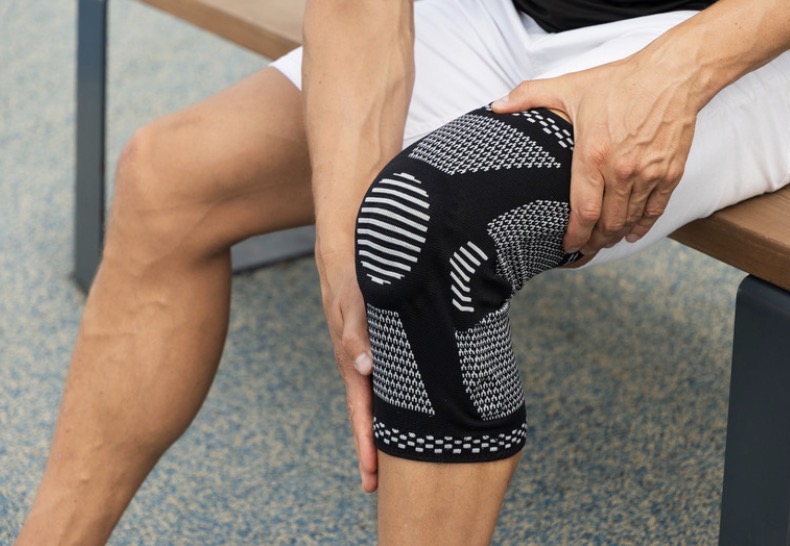
Can a knee brace help arthritis pain? Learn how knee braces work, who may benefit and how bracing fits into physiotherapy for knee osteoarthritis.
Knee arthritis can make everyday activities like walking, climbing stairs, exercising, or getting up from a chair increasingly uncomfortable.
If you’ve been diagnosed with knee osteoarthritis, you may have heard that a brace can help.
So, are knee braces actually good for arthritis?
For some people, yes.
But the type of arthritis, location of the symptoms, severity of the condition, and type of brace all matter.
How can a knee brace help arthritis?
A specialized knee brace can sometimes change how forces are distributed through the knee.
This can be particularly useful when arthritis affects one compartment of the knee more than others.
The American Academy of Orthopaedic Surgeons gives knee bracing a moderate-strength recommendation for improving pain, function, and quality of life in people with knee osteoarthritis.
The American College of Rheumatology/Arthritis Foundation has also recommended certain tibiofemoral braces for knee osteoarthritis and conditionally recommended patellofemoral braces in appropriate patients.
What is an unloader knee brace?
An unloader brace is designed to redistribute pressure away from a specific area of the knee.
This can potentially be useful when arthritis is predominantly affecting one compartment.
Instead of simply compressing the knee, the brace uses its structure to influence how forces are transferred through the joint.
That makes it very different from a basic compression sleeve.
Is a knee sleeve the same as an arthritis brace?
No.
A compression sleeve may provide comfort and compression, but it doesn’t necessarily provide the same mechanical effect as a specialized unloading brace.
That’s why simply searching for “best knee brace for arthritis” can be misleading.
The best brace depends on where your arthritis is and how your knee behaves.
Does wearing a knee brace mean you don’t need physiotherapy?
Definitely not.
Bracing can be one component of a larger treatment plan.
Exercise remains an important part of managing knee osteoarthritis. The AAOS guideline recommends supervised, unsupervised, or aquatic exercise to improve pain and function.
A comprehensive rehabilitation program may include:
- Quadriceps strengthening
- Hip strengthening
- Balance exercises
- Mobility work
- Walking and activity progression
- Education about managing flare-ups
- Load management
- Weight-management strategies where appropriate
- Bracing when indicated
The goal isn’t simply to make the knee feel better today.
It’s to improve your ability to use the knee confidently tomorrow.
How do you know if an arthritis brace is right for you?
A proper assessment can determine:
- Which part of your knee is symptomatic
- How your knee moves
- Whether instability is present
- What activities aggravate your symptoms
- Whether bracing is likely to help
- What type of brace would be appropriate
This is particularly important with specialized braces because proper fitting can make a significant difference to comfort and function.
Knee arthritis physiotherapy in Hamilton
At Restorative Touch Physiotherapy, we take a treatment approach based on your individual goals.
If knee arthritis is making it harder to walk, exercise, work, or participate in the activities you enjoy, bracing may be one tool we consider—but it won’t be the only one.
If you’re wondering whether a knee brace could help your arthritis, book an initial consultation HERE with Restorative Touch Physiotherapy in Hamilton.