
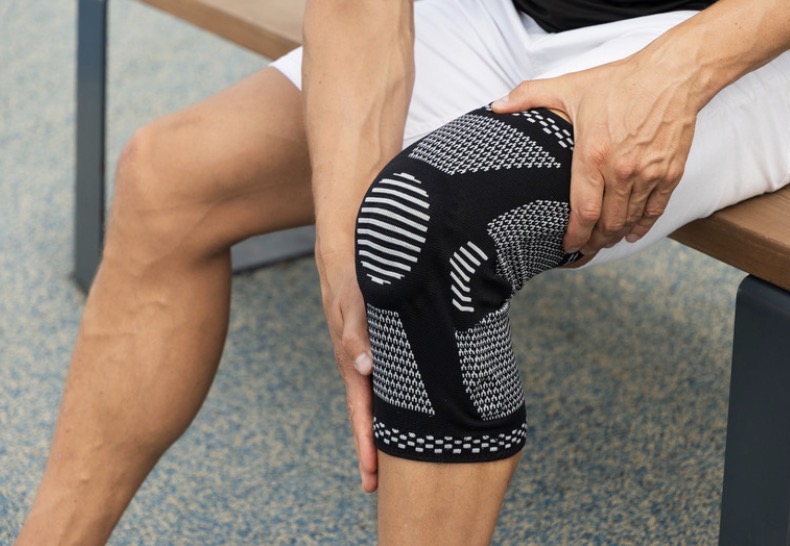
Wondering if you need a knee brace? Learn when knee braces can help with knee pain, instability, arthritis and sports injuries from Hamilton physiotherapists.
If you have knee pain, instability, or a recent knee injury, you may have found yourself wondering: “Do I need a knee brace?”
The answer isn’t always yes—or no.
Knee braces can be helpful for certain injuries and conditions, but the type of brace matters just as much as whether you use one. A compression sleeve, hinged knee brace, and unloading brace all serve different purposes.
At Restorative Touch Physiotherapy in Hamilton, we look at the underlying problem first and then determine whether bracing should be part of your treatment plan.
What does a knee brace actually do?
Depending on the design, a knee brace may provide compression, improve stability, limit certain movements, redistribute forces through the knee, or provide additional support during activity.
For someone recovering from an injury, that additional support can sometimes make everyday activities or a return to sport feel more comfortable and controlled.
However, a brace isn’t designed to replace rehabilitation.
Your long-term goal should generally be to restore the strength, mobility, balance, and movement control that your knee needs to function properly.
Who might benefit from a knee brace?
Knee bracing may be considered for people experiencing:
- Knee instability
- Ligament injuries
- Certain meniscus injuries
- Knee osteoarthritis
- Pain during physical activity
- Post-operative rehabilitation
- Sports-related knee injuries
- Recurrent episodes of the knee giving way
The appropriate brace depends heavily on the diagnosis.
For example, research reviewed by the American Academy of Orthopaedic Surgeons found that bracing can improve pain, function, and quality of life for some people with knee osteoarthritis.
Knee sleeve vs. knee brace
This is an important distinction.
A knee sleeve generally provides compression and mild support. It may be useful for someone looking for comfort, warmth, or compression during exercise.
A hinged knee brace provides more structural support and may be appropriate when additional stability is required.
An unloader brace is designed to redistribute load away from a particular part of the knee and may be considered for certain people with knee osteoarthritis.
So if you’ve searched for the “best knee brace,” the better question is:
What type of brace is best for my particular knee problem?
Can a knee brace make your knee weaker?
A brace shouldn’t be considered a replacement for strengthening.
If you’re relying on a brace without addressing the underlying weakness, mobility restrictions, balance deficits, or movement problems, you’re potentially missing an important part of your recovery.
Think of the brace as a tool.
Your physiotherapy program is what helps you build the capacity to eventually rely less on that tool.
How tight should a knee brace be?
A knee brace should feel secure without being painfully tight.
You shouldn’t experience:
- Numbness
- Tingling
- Significant discomfort
- Skin irritation
- Changes in circulation
- Increasing swelling
If the brace constantly slips or causes discomfort, you may have the wrong size or design—or it may not be positioned correctly.
Do you need a knee brace?
That’s where an assessment can be valuable.
At Restorative Touch Physiotherapy, our Hamilton physiotherapy team can assess your knee, identify the likely source of your symptoms, and determine whether bracing makes sense for your goals.
Sometimes the right answer is a brace.
Sometimes it’s a different brace.
And sometimes the best option is no brace at all.
The important thing is making that decision based on your injury—not simply choosing the most expensive product on the shelf.
If you’re experiencing knee pain or instability and aren’t sure whether a knee brace would help, contact Restorative Touch Physiotherapy in Hamilton to arrange an assessment.