
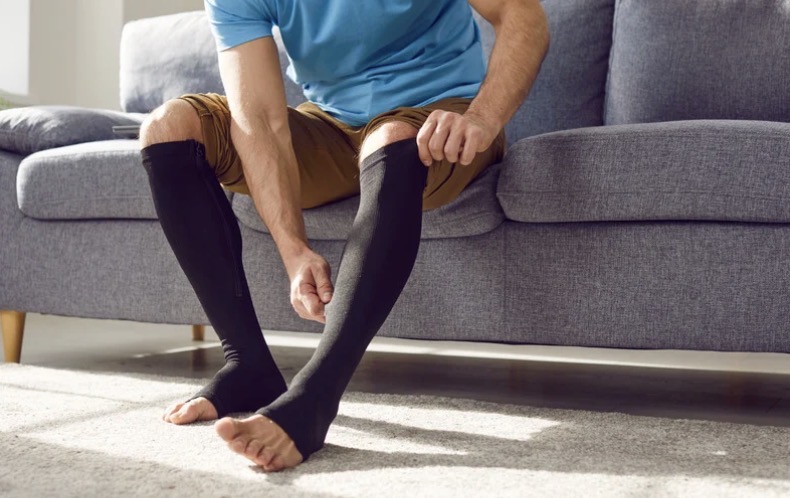
If you’ve ever walked into a pharmacy or sporting goods store, you’ve probably seen an entire wall of compression socks.
Some are marketed for runners. Others are designed for travel, swelling, pregnancy, standing jobs, or vein problems.
But do compression socks actually work?
Yes—but it depends on why you’re wearing them.
Compression socks aren’t a cure-all, and they aren’t equally useful for everyone. Their potential benefits depend on the amount of compression, how the sock fits, and the reason you’re using it.
At Restorative Touch Physiotherapy in Hamilton, we help patients determine whether compression is appropriate for their individual needs and what type of compression may make sense.
What Are Compression Socks?
Compression socks are designed to apply pressure to the lower leg.
Graduated compression socks generally provide greater pressure around the ankle, with progressively less pressure further up the leg.
The goal is to help manage fluid accumulation and support venous blood flow from the lower limbs back toward the heart.
Compression products are used clinically for conditions involving lower-limb swelling and venous problems, although the appropriate level of compression varies considerably depending on the condition. (Nice)
What Can Compression Socks Help With?
Compression socks may be useful for several different situations.
Leg swelling
If your legs or ankles tend to swell after prolonged sitting or standing, compression may help manage the accumulation of fluid.
This can be particularly relevant for people whose jobs involve spending long periods on their feet.
Travel
Long periods of sitting during flights, car rides, bus trips, or train journeys can increase the risk of blood clots in some people.
For travellers with certain risk factors, graduated compression stockings may help reduce the risk of asymptomatic DVT. The CDC also recommends regular movement and calf exercises during long journeys. (CDC)
Compression socks aren’t a substitute for getting up and moving around.
Think of them as one part of a travel strategy.
Vein-related symptoms
Compression can sometimes help manage symptoms associated with venous problems, including sensations such as aching, heaviness, and swelling.
However, compression isn’t automatically the first-line treatment for every person with varicose veins. NICE recommends that people with symptomatic varicose veins be assessed appropriately and that compression hosiery not be used as permanent treatment when definitive treatments are suitable. (Nice)
Exercise recovery
This is where things get interesting.
Some research suggests compression garments may reduce perceived muscle soreness and may have modest effects on aspects of recovery following exercise. (PubMed)
However, the evidence isn’t completely consistent.
A 2025 systematic review found that wearing compression socks during running did not significantly improve running performance, physiological outcomes, or perceived exertion compared with regular socks. (PubMed)
So if you’re buying compression socks because you expect them to make you dramatically faster, we’d pump the brakes a little.
If you like how they feel during or after training, that’s a different story.
Are Compression Socks Good for Runners?
They can be comfortable for some runners, particularly during recovery.
But compression socks shouldn’t be viewed as a performance-enhancing shortcut.
Your training, recovery, sleep, nutrition, strength, and running mechanics are going to have a much larger impact on performance.
Compression socks may be a useful addition to your routine—but they aren’t going to turn a 5K into a 4K.
How Tight Should Compression Socks Be?
Compression socks should feel snug.
They shouldn’t feel painfully tight.
You shouldn’t experience:
- Numbness
- Tingling
- Significant pain
- Skin colour changes
- Excessive pressure
- Significant discomfort
Fit matters.
A poorly fitted compression sock can be uncomfortable and may not provide the intended compression.
Who Should Be Careful With Compression?
Compression isn’t appropriate for everyone.
People with known or suspected peripheral arterial disease, certain forms of neuropathy, significant skin problems, or other vascular concerns may require medical assessment before compression is used. Clinical guidance also emphasizes appropriate sizing and fitting. (Nice)
If you’re unsure whether compression is appropriate for you, it’s worth getting assessed rather than simply purchasing the strongest pair you can find.
Compression Socks in Hamilton
At Restorative Touch Physiotherapy, we can help determine whether compression is appropriate for your symptoms, lifestyle, work demands, travel plans, or exercise routine.
The goal isn’t simply to put you in compression.
It’s to determine whether compression is the right tool for you—and how to use it properly.
If you’re dealing with swollen legs, heavy legs, discomfort after standing, or you’re looking for compression for travel or exercise, contact Restorative Touch Physiotherapy in Hamilton to discuss your options.